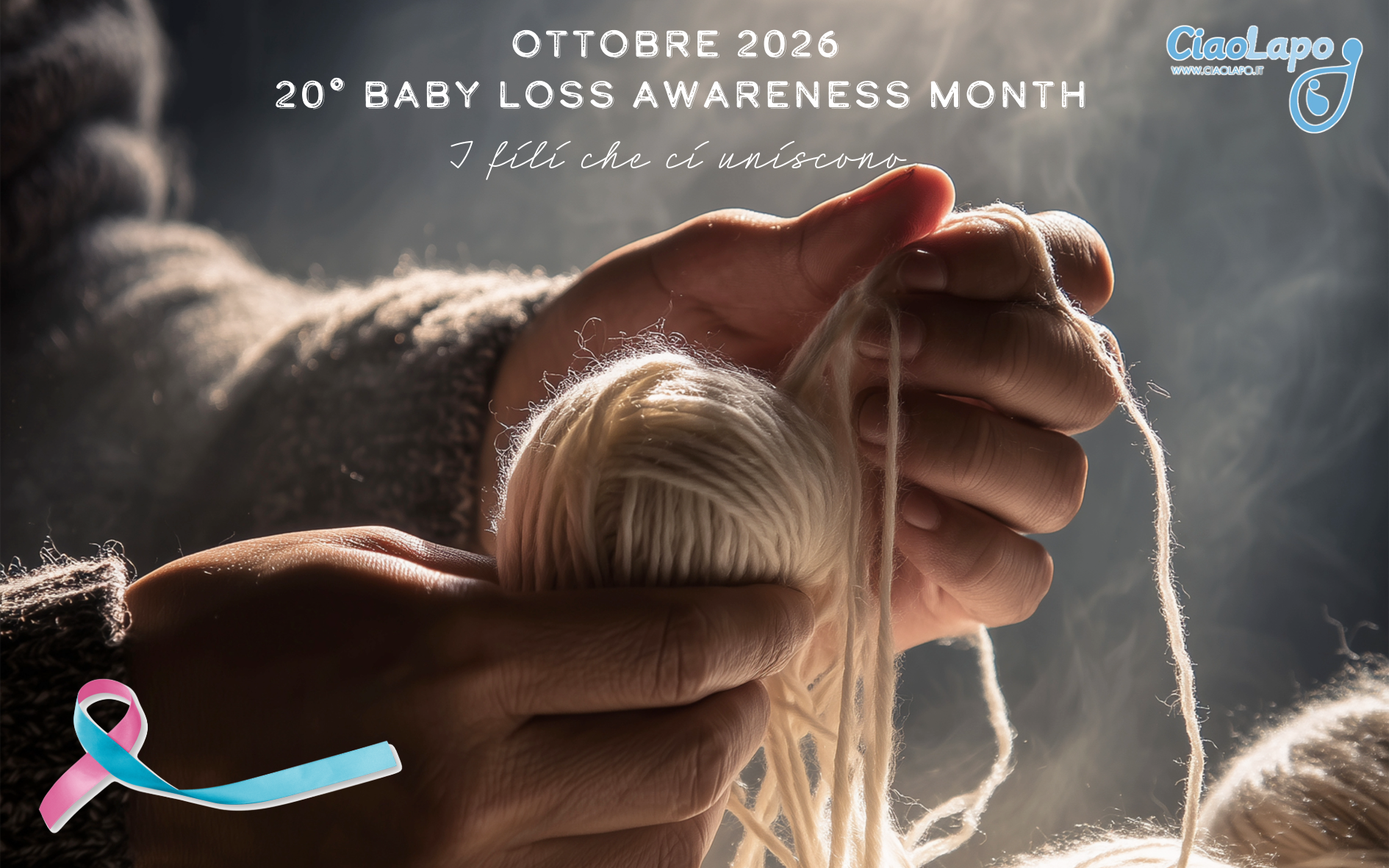
October is Baby Loss Awareness Month, dedicated to raising awareness about perinatal and infant loss: the goal of this observance is to raise awareness and make visible to everyone the experiences of loss during pregnancy and after birth, reduce disparities and inequalities among hospital departments, municipalities, regions, and countries, combat indifference, and promote a culture that truly recognizes families’ grief and their needs.
For twenty years, CiaoLapo has been working to ensure that this awareness translates into tangible change in care, education, research, and society.
Every day, we work to ensure that families facing a loss can meet with trained professionals, receive appropriate information, be guided in their decisions, and find—both inside and outside the hospital—resources and services capable of supporting them.
We conduct research, train and support healthcare professionals involved in care, promote best practices, and help develop care pathways that are not dependent on where the loss occurs or the stage of pregnancy.
This year , we have chosen “The Threads That Bind Us” as the theme for BabyLoss : we would like to thank all the people who, over the past twenty years, have helped us bring about change and who continue to be part of a vast network that spans all of Italy and adds new, strong links every year.
Today, there are stronger networks between families and the professionals who assist them, between hospitals and community-based services, between research and clinical practice, between universities and healthcare settings, and between associations and institutions. Connecting people, experiences, and expertise allows us to transform what we learn from one another into knowledge, and that knowledge translates into better practices and greater well-being for all.
For us, this is what BabyLoss is all about: making perinatal and infant loss visible and speakable, and creating strong connections capable of bringing about change.
BabyLoss 2026: Two Stories to Discuss Support
To mark BabyLoss Awareness Month 2026, APS CiaoLapo ETS and the CiaoLapo ETS Foundation donated two recent publications from CiaoLapo Edizioni— *Vai sereno* and *Ciò che rimane di noi*—to the departments participating in the Footprint Registry.
The two works are based on autobiographical experiences and describe profoundly different care pathways. In one case, the loss was not followed by any specific support; in the other, the principles of bereavement care were applied as part of a process in which all hospital and community care providers involved in the patient’s care had completed the Memory Box training.
Comparing these two experiences side by side allows us to see, through the words of those who have experienced loss, how what happens during and immediately after a loss can affect families’ experiences and their journey moving forward.
This is also what the data collected by our OPALE Observatory and the research conducted in recent years show us: psychological well-being after a loss is closely linked to the quality of care received and to the knowledge, application, and adherence to best practices by healthcare professionals.
Today we know that even in Italy, bereavement care is not something to be left to chance, common sense, or the sensitivity of the individual, but is an integral part of patient care.
Nearly Fifteen Years of Memory Box
CiaoLapo’s Memory Box project has been active since 2012 and is approaching its fifteenth year of operation. During this time, the project has evolved and grown through ongoing dialogue with families and ward staff.
The feedback we’ve gathered over the years has helped us understand which items parents and families appreciate over the long term: these include the booklet for collecting memories and the baby’s footprints, the blanket and hat, the security blanket, the symbolic birth certificate, and the book *The Little Princes*.
Year after year, we have developed new Memory Boxes based on feedback from parents and professionals, leading up to the latest version, unveiled this October: a precious space capable of preserving the child’s memories, acknowledging and affirming the child’s existence—however brief—while at the same time helping parents tell the story of that child and their own story of parenthood.
The Memory Box affirms the dignity of every story and its right to be remembered and told in its entirety.
Starting in 2027, the project will take another step forward: in addition to the Memory Boxes already in use from 18 weeks onward, we are designing a specific kit for miscarriages between 14 and 18 weeks, with materials tailored to the characteristics and needs of this stage of pregnancy.
The Next Step: Early Losses and the Piccole Stelle Project
Regular discussions with members of the Footprint network and with the thousands of women and families who have come into contact with CiaoLapo over the years have also clearly highlighted the difficulty of providing adequate support for first-trimester losses and, more generally, during the first half of pregnancy.
In many settings, an early miscarriage is managed entirely in the emergency room. The woman receives a diagnosis, undergoes the necessary tests and procedures, and returns home without accessing a structured bereavement care program.
This initiative requires tools different from those we have developed to date: over the past few years, we have gathered the testimonies of those who receive a miscarriage diagnosis, and we have asked ourselves what concrete actions are possible in settings characterized by different timeframes, spaces, and care models. Over the next five years, thanks to the the Piccole Stelle project, we will focus on early pregnancy losses and strive to raise awareness about this widespread yet neglected issue.
Everyone can help bring about change
Changing attitudes toward perinatal bereavement does not depend solely on institutions, healthcare professionals, or researchers. Everyone can contribute, and everyone can make a difference by accelerating this change:
Students can do this by choosing to dedicate their thesis to the study of perinatal bereavement, the needs of families, and care practices. Each research project helps shed light on a specific aspect of the issue, gather data, and bring these topics into universities and future healthcare professions. WWe would like tothank our students and their advisors for their sensitivity, attention, and dedication;
Professionals working in hospitals, family planning clinics, and community-based services can do this by observing what happens in daily practice, questioning existing procedures, proposing new approaches, and helping to spread best practices. We would like to thank all the healthcare professionals who train with us and make room—in their hearts and minds—to welcome and support families experiencing perinatal bereavement;
Mothers and fathers can do this themselves: their testimonies are one of the most important sources for understanding what really happens during care, what was helpful, what was lacking, which words, gestures, and choices left a positive impact, and which aspects, on the other hand, need to be changed. CiaoLapo maintains a permanent observatory on perinatal bereavement and the care received, in which people can participate anonymously. The participation of many people makes it possible to transform individual experiences into knowledge, identify critical issues and differences in care, and guide research, training, and future actions.
Sharing your story today helps build better support for those who will face a loss tomorrow.
Spreading accurate information and raising awareness in a way that is respectful of the complexity of this issue is also a way to bring about profound and truly transformative change: Anyone reading this article can share it, spread the word at their hospital, health clinic, university, or within their network of contacts, and thus help bring these issues to places where they are still rarely discussed.
From Awareness to Care: The Bonds That Unite Us
BabyLoss Awareness Month is an opportunity to revisit an uncomfortable topic that many people still find difficult to discuss: talking about perinatal and infant loss is still frightening, to the point that it remains a niche topic, reserved only for “those who have been through it.”
It should be noted that the sheer volume of copy-and-paste promotional posts generated by AI, along with cartoons, memes, and stereotypes about grief circulating on social media, has not actually had a significant impact on care practices or on the understanding of the issue among those who have not personally experienced it (we’ll be discussing this shortly at a conference).
The barrage of social media posts, if not accompanied by rigorous educational and informational efforts and in-depth dialogue among all stakeholders, does not bring about any change on this issue, and people are left alone, without support, and with their phones full of clichés.
When we talk about awareness, we must keep in mind that we need to advance research, provide adequate training, and thereby foster real change in care practices and social support: everyone’s voice matters, everyone’s contribution matters, and collaboration matters.
October is a time to build strong connections and tighten any loose ends: it’s a time to take an honest look at what works and find the courage to try changing what needs to be changed.
It serves to bring people together, to share experiences, and to develop sustainable initiatives in our family planning clinics, our hospitals, our libraries, our general practitioners’ offices, our pharmacies, our town squares, our parks, our places of worship, our museums, at the beach, and in the mountains.
Everything is a community, and everyone can reach out to those whose heartache is too great to bear alone.
A tutte le madri, di tutti i tempi e di tutte le storie; a tutti i padri, lasciati in balia di vicende più grandi di loro; a tutti i bambini che con il loro passaggio hanno illuminato il buio dell’indifferenza, dell’approssimazione e della solitudine.
“Behind me lie millennia of silence, of attempts at poetry, of festive loaves, of threads from the loom.” Maria Lai