I interviewed Federica Attanasi, author of “The Shape of Emptiness,” a poetic collection of words and images about perinatal grief.
Writing has been my way of breathing inside the void. Painting, my way of giving it color.
1.Hi Federica, can you tell us how your book came about?
Months ago I was pregnant with our second child.
We have been searching and longing for him for a long time, and knowing that we are waiting for him has filled all three of us with endless joy.
Then during a visit we learned that he could not be born, and our world collapsed.
Together we put the pieces back together, we shared the pain, me my husband and my son.
After interrupted motherhood, I was faced with an emptiness that demanded to be heard and felt a thousand confused emotions: loneliness, guilt, inadequacy, fear of forgetting.
I have always sought the answers to my questions in books, and so I did on this occasion as well: I read Small principles: going through perinatal grief.. It was not decisive of course, but thanks to this book I slowly began to recognize that my grief had dignity. It was the first step in accepting what had happened. The first step to make peace with myself, to accept myself.
At the same time, I resumed painting, an activity that makes me feel good and that I had been practicing for years but had stopped doing when I felt lost. I started writing the poems in this book. I was writing for me, in my journal, to draw out my emotions, to analyze them, to ease the fear of forgetting.
Writing and painting were healing gestures, ways to breathe and transform pain into something that could be received.
The Shape of the Void was not a project thought out at the table, but an urgency: to give shape to the shadow in order to cross it. It was supposed to be something private; I never thought I would have my poems read. Then I thought back to how good it had done me to read Little Princes or other “feel-good” books like Nobody Knows About Us and I thought that maybe even my small contribution could help someone cope with their loss. So I picked up everything I had written and painted, organized them in the way I thought they might represent my grief journey, and made a book out of them.
2. Tell us briefly what is it about?
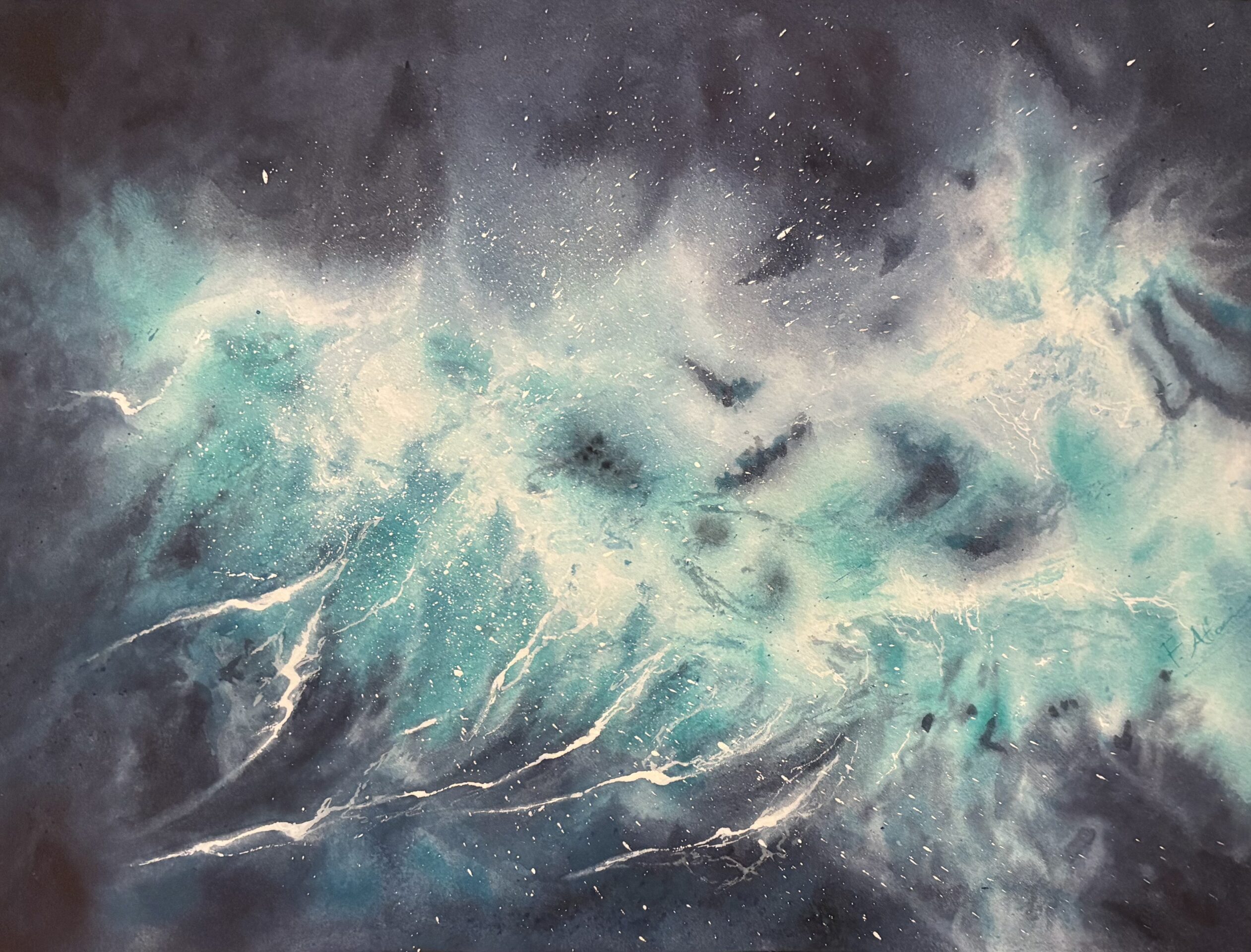
The Shape of Emptiness is a collection of poems and watercolors that chronicles my journey of processing perinatal grief. It is divided into three sections: the first is the time of raw grief, of interrupted motherhood; the second is a diary that relies on colors to say what words are not enough to express; the third is the present, the time of newfound stillness, of light that gradually returns. It offers no answers, but space: to listen, to stay, to transform.
3. If you had to tell the heart of your book by choosing one image from those you painted or one sentence from those you wrote, which would you choose? Because?
I would choose the watercolor and the poem I, Empty, Hidden in the Grass and Sunrise.
Me, empty because it represents the moment when I stopped fighting the emptiness and began to embrace it. That is where pain found a form and life began to flow again. In those words and colors is the realization that even emptiness can become home, that it does not have to be filled with something, but that it has to be welcomed and will be part of our lives.
Hidden in the grass because it describes vulnerability, but also ability to withstand pain.
Finally, Alba is a hymn to life beginning again, even if it is different than imagined.
These three images tell the story of my journey: from welcoming emptiness, to silent resistance, to rebirth.
4. Are there any words that, while writing the book, came back again and again? And others that instead, you chose to leave aside, not to say? Because?
Words like “emptiness,” “light,” “shadow,” “breath,” and “home” returned often, because they were at the heart of my experience. I avoided clinical terms, rational explanations or justifications, because I wanted the pain to remain authentic, without being reduced to a concept. I chose to leave room for emotional truth, even when it was uncomfortable. A part of me left that day with him, and I could not reduce the sea that moved inside me to a clinical definition. I loved my baby, even though I never held him, kept him safe as long as I could, then let him go while facing the most difficult decision of my life.
5. Can poetic making and artistic expression transform the grieving process? If so, how?
Yes, deeply. Creating is an act of caring, a means of analyzing, understanding, processing one’s emotions, but also for those who observe them, read them, experience them. Poetry and painting do not erase pain, but give it form*. They allow us to stand by absence without fear, to transform silence into voice and emptiness into habitable space. When we write or paint, we do not seek to forget, but to welcome. And in that welcoming is born the possibility of rebirth. They are both languages that work by images: they do not require us to explain too much but to bring out emotions. This characteristic has made them useful tools for me in coping with grieving, because compared to diaristic or narrative writing the not having to describe, justify rationally, have made me free to express and understand myself.
In general, I think any language that allows you to reflect, listen to yourself and let your emotions out is helpful in such a journey: it is a way to talk, not to hide what you are experiencing. It is the first step to continue living.
*We will be doing poetry together again in 2026, at the found poetry meetings for parent members.
6. Is there a sentence from your book that you feel sums up your journey and that you would like to share with those reading us today?
“Even the emptiness
Can become home.
And in me,
slowly,
a place grows
Where absence can flourish
Without needing to be filled.”
I believe that even emptiness can become home. That even absence can teach how to live. It is the verses that encapsulate the meaning of it all: not to deny what is missing, but to learn to live with it, until it becomes part of one’s own story.
7. What would you like to say to someone who is going through perinatal grief and perhaps cannot yet find words or gestures for themselves?
Do not be afraid to listen to your pain, your emptiness. No need to rush toward answers or solutions. Stay, breathe, if you can write, paint, dance, or simply let the silence speak to you. Every voice deserves space and every form is possible. Grief is not overcome, it is walked through. And on that path, even if it seems impossible today, a new light can be born.
Today it seems impossible, but the light returns. Not to erase the pain, but to walk beside it.
8. To whom is this work of yours dedicated?
It is dedicated to my baby, my little blue flower, who will stay by my side forever.
It is dedicated to those experiencing similar pain so that they may feel less alone.
It is also a gift to my family, who walked with me through the shadows, and to those who believe that beauty can be born even from absence.
Thank you Federica!
Federica donated some copies of her book to our association to support our activities. You can receive a copy in exchange for a donation here.
Cover image: watercolor by the author