
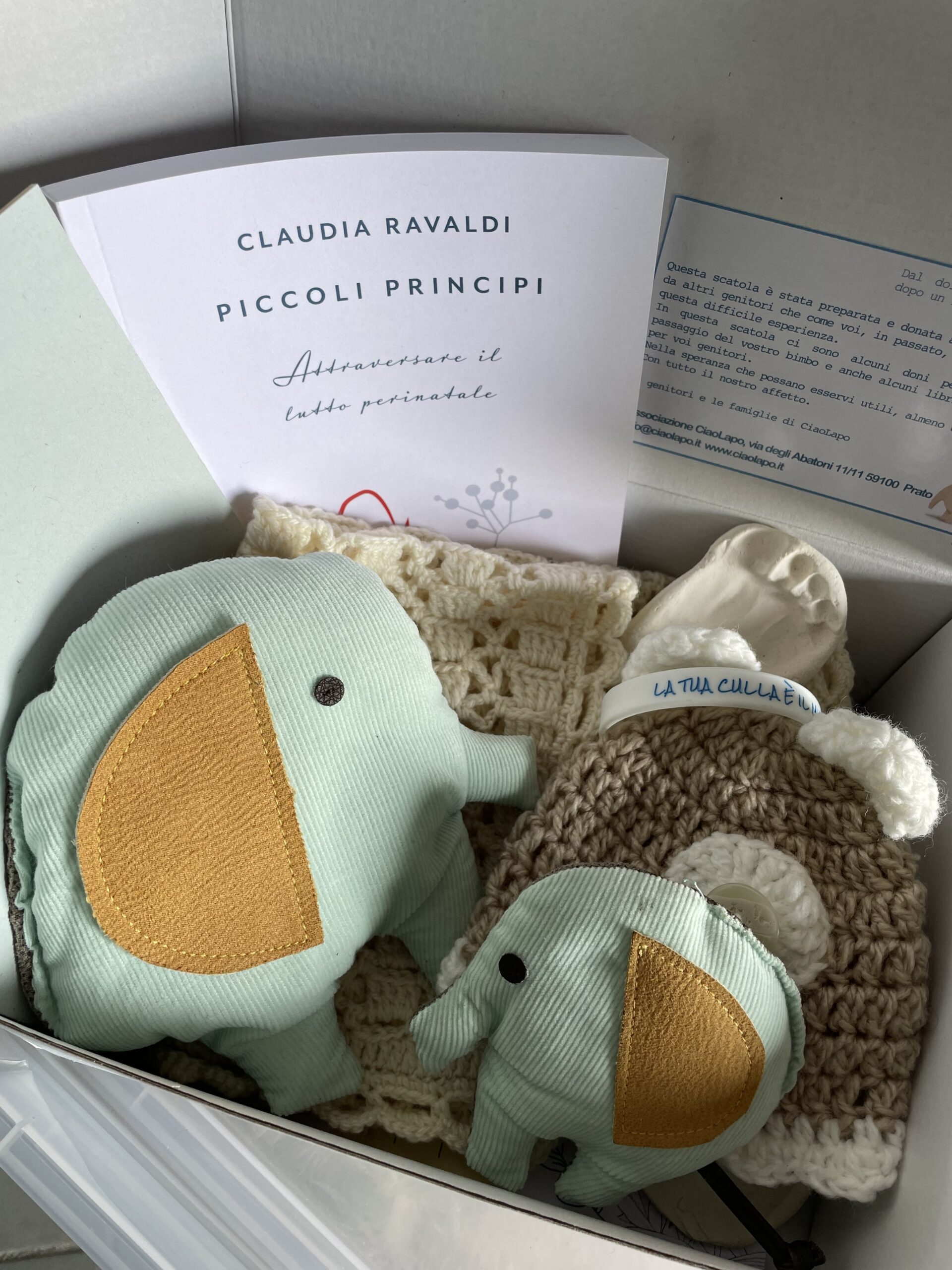
We have been involved in training in Italian hospitals since 2007; in 2022, we launched the Memory Box project, which has already involved thousands of hospital health workers, students and student trainees from wards in dozens and dozens of Italian hospitals , and established the Footprint registry, which collects wards that have reached at least 70 percent of staff trained to provide respectful, trauma-oriented perinatal bereavement care. Three years after the project’s inception, we asked the referring midwives in each department to tell us their views on care, what has changed and what remains to be improved, and what are the most difficult aspects, emotionally and care-wise. The material, compiled in a very dense focus group, went into Dr. Caterina Mussoni ‘s dissertation on midwifery at theUniversity of Bologna, with correlation from the CiaoLapo Foundation.
This is how our invaluable midwife colleagues responded, to whom, as always, our greatest thanks go.
The importance of personalization of care
When we ask midwives about how they accompany parents, it quickly emerges that every story is different. In fact, there are no protocols that can contain the variety of human reactions in the face of loss: there are those who want to see their baby right away and those who vehemently refuse, those who want to hold their baby for hours and those who need time to accept even the idea of meeting.
The professionals describe an accompaniment made first of all of respect for these very personal times.
“It is being the first ones to bring the gesture of love toward this child, almost as if this gesture of love is really a way of acknowledging it, of saying that this child is there.”
Caring for the dead baby-washing him, dressing him, stroking him-becomes the first act of recognition, the first message to the parents that that baby, no matter how short his life was, existed and is worthy of love and dignity. This gesture by midwives often paves the way: when parents see that their baby is treated with gentleness and respect, something melts, a door opens.
The memory box and the collection of mementos-footprints, photographs, a tuft of hair, the hospital bracelet-are now established practice in wards that have completed training. But the testimonies reveal how important the way these gestures are offered is: never imposed, always offered gently, respecting even initial rejection and leaving open the possibility of reconsideration. One professional recounts preserving the baby’s body so that it remains available for the encounter even hours or days after delivery, respecting the parents’ processing time.
Particularly poignant is the account of a case in which the father was ready to meet his child while the mother was still in absolute denial. The midwife accompanied the father, and while the father dressed the child, the mother followed them from a distance, finally entering the room when she felt ready. Fathers, this research reminds us, experience grief often ignored, in different ways and at different times than the mother, and deserve attention and recognition in their journey.
When hospital service organization makes a difference
Quality care depends not only on the individual skills of midwives, but also-and perhaps most importantly-on the organization that supports them. The research highlights some elements that really make a difference.
Continuity of care is one of them. When the same midwife (or the same small group of professionals) accompanies the couple from diagnosis to follow-up, a bond of trust is created that facilitates the entire journey.
“By maybe finding the same person, you can put aside all that part of the work that even trivially the couple has to do on trust, on reopening and instead continue to work on the processing path.”
This is not always possible-shortage of staff, shifts, organization prevent it-but where it is guaranteed, the results are evident.
Dedicated spaces are another crucial element. It means having a reserved clinic for diagnosis, where parents do not have to wait in the waiting room with other couples expecting a live baby. It means having a delivery room that is a little more secluded, quieter, where the cries of other newborns do not come to add to the pain. It means having an inpatient room where the family can be together, with no time limits, where grandparents, little brothers and sisters can come in, where time can stand still without the anxiety of constant doctor visits.
Personalization of care emerges as a core value: each family has different needs, different cultural roots, different religious beliefs. Some ask for baptism in the delivery room, some want a blessing according to their religious rite, some want all relatives to come and greet the baby. Midwives tell of having “invented” creative solutions when protocols were not enough: a photo montage for a mother who wanted a picture with both her twins (one alive and one dead), a meeting in a bar because the parents did not feel like going back to the hospital, the organization of special rooms to accommodate large family groups according to specific cultural traditions.
But the organization also shows its cracks. The presence of the 24-hour caregiver, for example, is guaranteed in cases of bereavement but not uniformly regulated. Follow-up exists but is fragmented. Most importantly, as we shall see, the organization hardly provides structured forms of support for the caregivers themselves.
Training as the cornerstone
If there is one message that emerges strongly and unanimously from the research, it is this: training changes everything. Midwives who have participated in courses specifically on perinatal bereavement-such as the Memory Box course offered free of charge by CiaoLapo-tell of a before and after in their professional practice.
“For us, it changed so much about care, including communication of course, and we enjoyed the fruits from a satisfaction standpoint,“ says one professional. The training not only provides technical and practical tools, but helps develop the emotional awareness needed to remain present without being overwhelmed, to be empathetic without losing professional boundaries.
One participant recounts how the training taught her to ask herself “how am I doing?”, to recognize when she needs to take a step back, when personal emotionality threatens to negatively affect care. Another describes how, after the training, the team felt the curiosity to devote themselves to younger children as well, those of earlier gestational ages, compared to whom they had previously felt less competent.
But training remains uneven. If the midwives in
The professionals therefore call for ongoing, multidisciplinary training involving all the figures who revolve around the bereaved couple. Because quality care is built together, in the homogeneity of approaches, in the consistency of messages, in the sharing of a culture of respect and empathy: for this reason, the CiaoLapo association offers a three meetings a year of supervision for all hospital referrals involved in the Memory Box project and refresher training every three years to all professionals.
In conclusion
Perinatal bereavement care is not “just” a clinical act to be included in protocols. It is a deep relational process that touches the most intimate strings of the human – life, death, parenting, grief, hope.
Midwives who accompany families in these moments bring to their work not only technical expertise but also their heart, their humanity, their vulnerability. And they often do so without the organizational, psychological and training support that would be needed.
Yet, despite the difficulties, the gaps, the emotional burden, these professionals continue to “stay,” to “be there,” to seek the right words or respectful silences, to care for dead children as lovingly as they would care for living ones, to support parents in acknowledging their loss but also their experience of parenting.
Here’s what we still need to do:
- Ongoing and multidisciplinary training: not only midwives, but also all the rest of the team must train with a focus on effective communication and interpersonal skills.
- Structured psychological support for operators, with debriefing, supervision and support pathways that prevent burnout and enable them to process the emotional burden.
- Institutional recognition of perinatal death as an integral part of midwifery practice, with dedicated resources, protected time, appropriate spaces.
- Care organization that promotes continuity, personalization, the presence of dedicated spaces and clear and shared pathways.
Read more
This research is an important contribution to the Italian literature on perinatal bereavement and offers concrete insights for improving care. If you would like to learn more about the findings, methodology, and full testimonies of midwives, you can read the full thesis here.
We thank newly appointed obstetrician Caterina Mussoni for giving voice to those who care for families on a daily basis and for contributing her work to building a more knowledgeable, humane, and just culture of care.
For information on perinatal bereavement training for health professionals, visit the dedicated section of our website. For support for families who have experienced loss, call toll-free 800 601660 or contact us at primosostegno@ciaolapo.it.