Grieving, at first, takes away our words, takes them away, hides them, breaks them, empties them of meaning. For weeks, months, years, bereaved parents know that one of the most exhausting things is to find their words, to say them, to tell themselves, to be whole again. In nearly twenty years of CiaoLapo, I have seen thousands of parents work hard to find the right words for them, for their stories, for their children.
Many of them found them, and turned the unspeakable into sayable, the unthinkable into thinkable, pain into hope.
Others, are still searching. When trying to rebuild after perinatal grief, words must be chosen with care: sometimes they are born within us, spontaneous, other times they must be borrowed from those who have found them before us: and it is then the poets and poets, the authors and authors, the other mothers and fathers who offer, through their stories, words that can be both healing and budding at the same time.
After a lot of feverish work, Marta one day found the right words to tell her story, to tell it to the world: a book was born, Gold is Expected, for which I edited the preface^: “Gold is Expected is a book that comes from the heart and to the hearts it addresses: it was written by someone who has experienced perinatal grief firsthand, and it speaks the universal language of bereaved parents. Although going through grief is a subjective and deeply personal experience, the journey, however, should never be a lonely one. To face the crossing, to brave the open sea, one needs to have trusted companions beside one, who can understand and speak our language. Well-written autobiographical accounts, written in words that shape personal grief while offering universal trajectories of meaning, provide a firm starting point. For in perinatal grief we can get lost, especially if we are alone, or in bad company: the words of other mothers and fathers can offer us points of view that can make a difference, in our own journey of processing.”
I asked Marta to tell us a little bit about her experience, starting from her story, from the beginning, when it all began:
“In 2019 I become a mother for the first time. Of all the thoughts I had had about my becoming a mother, certainly in my imagination I would never have thought of clutching my Nicco with the hope of dying at that instant. Yes because my Nicco was born quietly within a week of giving birth. Death in utero and all that goes with it: induction of labor, natural childbirth, breastfeeding, autopsy, funeral, cemetery. On the advice of the midwives, Nicco we hugged him, we have a picture of him, memories essential to the processing first and the transformation of grief later.
Niccolò is so named because I deeply love the music of Niccolò Fabi…. in fact, the title of the book is actually a phrase from one of his songs.”
When was your book born?
“The book was born between 2020 and 2021 while I was expecting my rainbow. Pregnancy after a death in utero is so psychologically challenging that either I would find a way to channel the anxiety or it would turn into hell.* Among the various things I was doing, writing was one of the things that most helped me to throw out the fears and anxieties.”
When did you think your story might be of use to other parents? “As I was writing I felt inside that those words could be helpful to other mothers, other fathers, other women and men. So word by word I thought about publishing the book. Writing was therapeutic because it allowed me to go through my story in an orderly way, one stage at a time, I was able to put my thoughts in order, it allowed me to pause again in my pain, to dissect it once more and give it a new shape.”
If there is one thing I have learned over the past six years since Nicco’s flight, it is that the transformation of grief is an ever-evolving process.
“When the publication of the book became real, I immediately told myself that the proceeds would go to charity. In fact, I donated the proceeds of the first edition to the Words of Lulu Foundation, and for the second edition I chose CiaoLapo: I know that these two entities, which I know personally, can help make my words ‘gold’ for some other person in the world!”
How important is sharing to you? “Sharing, or rather as I always write divide-with, is crucial to not being alone with and in one’s pain. Sharing one’s pain with people one empathizes with can make all the difference…or at least for me, for us, it did…it was the only weapon against despair to keep it from becoming torment.”
What would you like to say to parents who are facing perinatal grief now? “First of all that I am empathetically close to their pain and then I would say to be honest with their pain. To look at it in the face, and avoid pretending that they are not happy, avoid ‘avoiding’ it. To not pretend to be happy. Of experiencing the pain. Because even though we are immersed in a way of people who always show themselves happy and content, life is another story: the only way to be truly happy is to go through the pain, to go through it in order to arrive “safe in the harbor.”
You can find “Gold Expects” on Amazon° and among our handpicked “Books That Are Good For You”
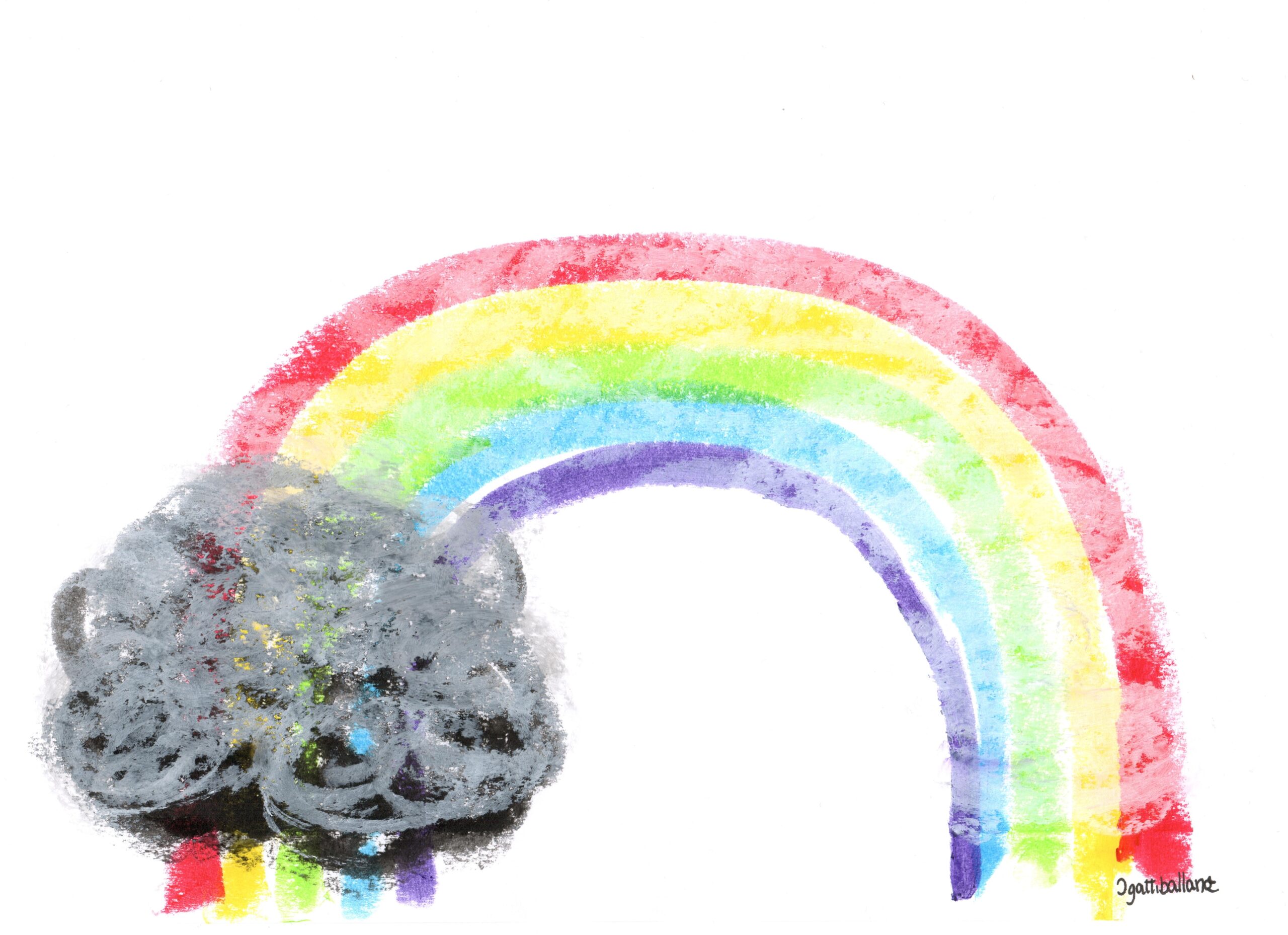
^ And also the cover, which I drew and fondly gave to Marta for her work.
* As of 2022 we have an accompanying course for post bereavement pregnancies, where among other things we read and write: you can find all the information here: rainbow course.
° Proceeds from the second edition of the book, net of printing costs, are entirely donated to our association.
Thank you Marta!