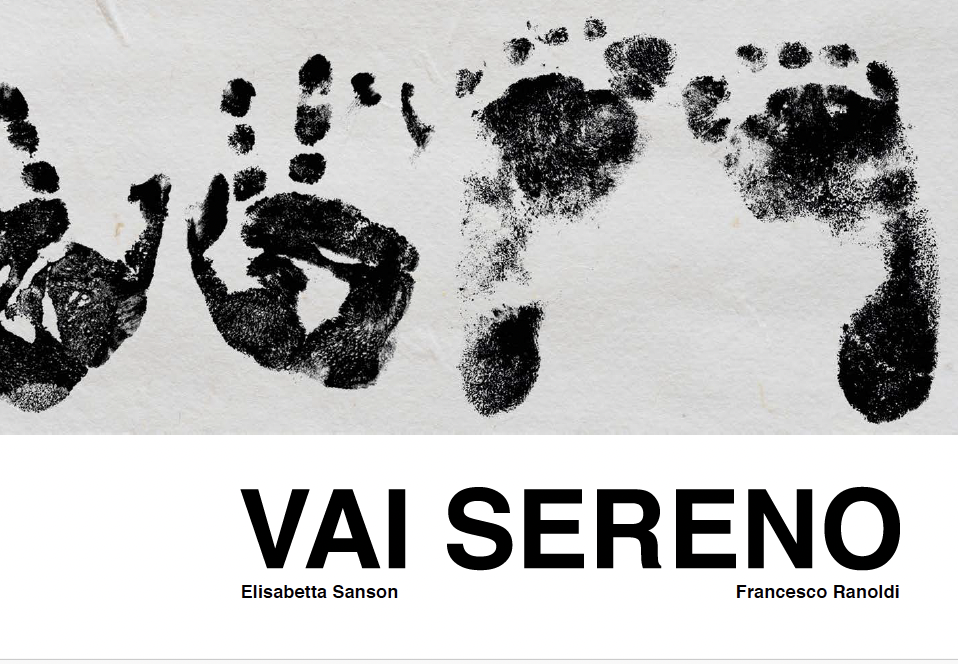
*Vai sereno* is a photography book by Elisabetta Sanson and Francesco Ranoldi, published in September 2026 by CiaoLapo Edizioni.
It tells the story of Liam and his parents through two intertwining threads, told with love and sensitivity: a father’s photographs and a mother’s words.
Liam is a much-wanted child who arrived after previous miscarriages.
Her anticipation brings with it a deep sense of happiness, which gradually replaces her fear. During her pregnancy, she receives a diagnosis of a teratoma that is incompatible with life.
In a very short time, Elisabetta and Francesco must come to terms with what is happening, face a prognosis with no possibility of a cure, and make the decision to terminate the pregnancy.
While in the hospital, feeling Liam move, Elisabetta wrote two words on a piece of paper: “Go in peace.” These words don’t take away the pain or make what’s happening any easier, but they are words to say goodbye to Liam: a way to tell him that he can go, that his parents will take care of the pain that remains.
That piece of paper becomes the thread that runs through the entire story.
Memories in Pictures.
Francesco is a photographer. During her pregnancy, he had imagined photographing Elisabetta with her baby bump and then newborn Liam, just as he had done many times with other families. After the terrible diagnosis—and after considering giving up—he found the strength, thanks to Elisabetta, to tell his family’s story using the medium he knew best.
He photographs the final days of her pregnancy, their home, nature, her admission to the hospital, labor, and the birth. Taking these photos allows him to find his own place in the experience—as a partner and as Liam’s father.
Accompanied by Elisabetta’s words, Francesco’s images tell the story of the journey from anticipation to diagnosis, from home to the hospital, and from labor to the moment of meeting.
One of the most important parts of the book is actually about birth.
Elisabetta describes labor as both a physical and a deeply relational experience. When Liam is born and placed on her chest, her doubts, fears, and anticipation give way to a moment of connection: looking at him, holding him skin-to-skin, and recognizing him as her own child.
Liam was born on April 10, 2026; he weighed 585 grams and was 32 centimeters long. Elisabetta and Francesco were able to spend the entire night with him.
The midwife brings them a CiaoLapo Memory Box: it contains their handprints, their blanket, their bonnet, and their birth information. These are small, tangible gestures that, after they go home, will become part of the family’s memories.
Having something tangible to remember is a way to cope with the pain of grief.
When a baby dies during pregnancy or shortly after birth, the time spent with the baby can be extremely brief. That is why the opportunity to see the baby, hold the baby, call the baby by name, and create memories is an integral part of the care provided.
The photographs, the footprints, a blanket, a bonnet, the bracelet, and the birth details are symbols of a relationship that, however brief, was intense and often overwhelming.
This passage is particularly clear in the book. When Elisabetta and Francesco leave the hospital, Liam is not physically with them. Elisabetta walks out clutching the Memory Box. The photographs taken by Francesco and the items collected during those hours will become some of the few tangible mementos of their child’s life.
Bereavement care also involves this: the ability of healthcare providers to recognize that, even when it is not possible to save a child’s life, it is still possible to care for the child, his or her parents, and the time that family has left.
What Comes Next
“Vai sereno ” doesn’t end with Liam’s birth.
It also tells the story of returning home, the postpartum period without a baby to care for, a body that still bears the marks of pregnancy and childbirth, the strain on the couple, and the people who don’t always know what to say or do. And it tells the story of the psychological support—both individual and group—received in the months that followed.
This is an important point because it highlights the duration of perinatal grief. The experience does not end with discharge from the hospital. Afterward, a new phase begins, during which parents must gradually find a place for what has happened within a life that goes on.
Four months after Liam’s death, Elisabetta writes that picking up the pieces of her life and writing this book also means keeping the promise she made in that hospital room: to let Liam “go in peace,” without burdening him with his parents’ grief.
A book born from a story, a book for many stories
*Vai sereno* draws on the personal experiences of Elisabetta and Francesco but speaks a language familiar to so many of us grieving parents: Through photographs and words, it recounts what it means to receive a life-threatening diagnosis, to be present at the birth of one’s child knowing that the time together will be very brief, to become parents amid an experience of loss, and to return home with memories in place of the child one had imagined bringing home.
Above all, it shows just how much of a difference it can make to be supported by trained professionals who are able to give both parents space and recognize the value of the time spent with the child. We cannot change what has happened. However, we can profoundly change the way a family is supported as events unfold and in the time that follows.
That’s also why CiaoLapo chose to publish *Vai sereno*: because stories are tools for awareness and change.
We would like to thank:
Elisabetta Sanson and Francesco Ranoldi, for the love, art, and awareness they have given to all of us;
Liam, a child who radiates beauty;
the staff of the Department of Gynecology and Obstetrics at Santorso Hospital in Vicenza, for their sensitivity and expertise, and for hosting regular training sessions and continuing education programs on the topic of perinatal bereavement.
All proceeds from this book will go toward supporting the Memory Box project.
Not Just a Book
The “Vai Sereno” Project is a traveling photography exhibition that aims to raise public awareness of the importance of photography in perinatal bereavement through the organization of the exhibition and the presentation of the book.